
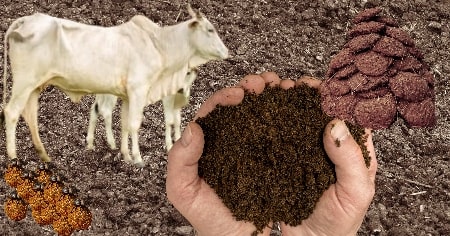
Dung to Gold — Organic Manure Production
A model for income and soil improvement using dung, urine and local bio-resources
1) Milk is not the only income source
Small livestock farmers often evaluate desi cows only on milk yield. But the true economic value of a desi cow also lies in dung and urine-based bio-products. Where milk quantity is moderate, savings on farming inputs and extra income from organic products can become very important.
2) The true importance of dung
- Improves soil structure
- Supports microbial life in the soil
- Can reduce dependence on chemical fertilizers
- Converts waste into usable farm wealth
3) Main products
a) Basic farmyard manure
The simplest form. If collected and decomposed properly, it becomes a strong soil-building input.
b) Jeevamrit
A liquid preparation made using dung, urine, jaggery, pulse flour and local soil, used to support microbial activity.
c) Ghanjeevamrit
A solid version of the same concept, easier to handle in some farm conditions.
d) Vermicompost
Where resources permit, this can become a value-added product.
4) Model for small farmers
A farmer keeping 2 to 4 desi cows can use daily dung output for soil improvement, nursery use, kitchen garden support and even limited local sale. This gives two kinds of benefit:
- Savings on fertilizer purchase
- Extra income from local sale of organic manure products
5) How to improve quality
- Keep dung free from plastic, stones and excess soil
- Compost systematically in shade
- Maintain moisture without waterlogging
- Turn the material periodically
- Do not use half-decomposed manure prematurely
6) Marketing opportunities
Organic farmers, kitchen gardeners, nurseries and orchard growers can be potential buyers. Small, clean, trustworthy packs can create a useful side income.
7) Conclusion
Dung from a desi cow is not merely waste. It is a source of soil health, farming resilience and additional income. For small farmers, this understanding can become a real economic turning point.
After this chapter, the farmer should start with at least two practical dung-based products.