
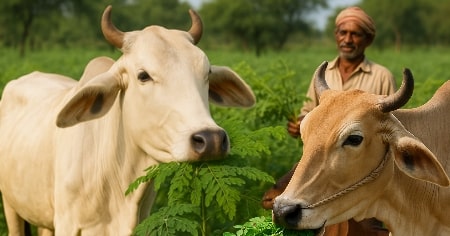
Zero-Cost Feed System
A low-cost feeding model based on local resources, crop residues and green fodder
1) Why is it important?
For a small livestock farmer, the biggest challenge is often not milk yield but feed cost. Many people assume that expensive feed automatically means better production, but in practice a balanced, local and consistent feeding system gives better profit. Desi cows adapt better to local feed resources, so a zero-cost or low-cost feeding model is especially useful for them.
2) Core principles of a zero-cost feed system
- Use resources available on the farm, around the house, or within the village first.
- Maintain a balance of green fodder, dry fodder, and safe local by-products.
- Do not change feed suddenly; make transitions gradually.
- Water, salt, and minerals are part of the feeding system, not separate extras.
3) Common local feed resources
- Crop residues: wheat straw, sorghum stalks, pearl millet residue, gram by-products
- Green fodder: berseem, lucerne, sorghum, millet, napier, local grazing grasses
- Leaf resources: selected safe tree leaves in limited quantity
- Useful household/farm by-products where safe and practical
4) Practical model for 2–4 desi cows
For a household keeping 2 to 4 desi cows, the best system is usually a mix of dry fodder, some green fodder, seasonal grazing, and limited concentrate only when required. This reduces cash outflow and still supports health and production.
- Morning: water + dry fodder + grazing/green fodder
- Midday: shade, clean water, salt/mineral support
- Evening: green fodder + dry fodder + limited concentrate if needed
5) Mistakes to avoid
- Depending only on straw
- Giving too much concentrate suddenly
- Using moldy, rotten or contaminated fodder
- Poor water availability
- Ignoring mineral and heat-stress balance in summer
6) Conclusion
Zero-cost feeding does not mean underfeeding. It means disciplined use of local resources in a scientific way. For small livestock keepers, this is one of the safest, most sustainable and most profitable feeding approaches.
After this chapter, the farmer should list five major locally available feed resources.