
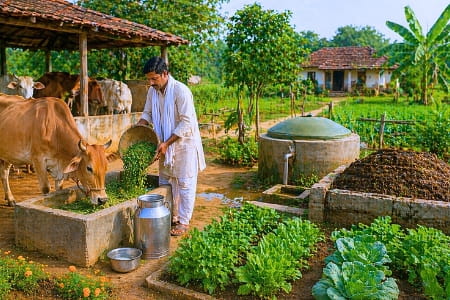
Integrated Model — Final Conclusion
A complete income transformation model integrating feed, health, bio-products, branding and records
1) The course summary
The core message of this course is that a desi cow should not be judged only by milk quantity. Its real value lies in adaptation, lower disease risk, local feed efficiency, dung and urine-based value, and trust-based local marketing.
2) The five pillars of the integrated model
- Low-cost balanced feeding
- Preventive health management
- Dung and urine based value addition
- Trust-based local branding
- Record keeping and practical calculation
3) What this means for a small farmer
If a farmer builds a disciplined system around 2 to 4 desi cows, he can develop multiple value streams instead of depending only on milk. This is the real basis of income transformation.
4) What should not be done?
- Blind imitation of the HF model
- Expansion without understanding the market
- Decisions based only on emotion or exaggerated claims
- Investment without records
5) What should be done?
- List local resources clearly
- Start with a small pilot scale
- Review every 30 days
- Strengthen what is already working
6) Final message
Desi cow based income transformation is not an overnight miracle. It means building a sustainable, practical and respectable model suited to the farmer’s own conditions.
7) Conclusion
The farmer who builds a system is the farmer who builds profit. A desi cow can become the center of that system when understood correctly and managed with discipline.
This final chapter gives the farmer a direction to apply the complete model at his own scale.